Showing posts with label Viking literature. Show all posts

Thursday, April 16, 2015

The Poetic Edda - Voluspo : Stanza 20 - The Norns

The Norns also call upon me this day to tell their tale this day from the Voluspa/Voluspo . So I will honor them and their words and do so. BlessedBe.

20.  Thence come the maidens  mighty in wisdom,
       Three from the dwelling  down 'neath the tree;
       Urth is one named,  Verthandi the next, --
       On the woods they scored, --  and Skuld the third.
       Laws they made there,  and life alloted
       To the son of men,  and their fates.


The Poetic Edda - Voluspo: Stanza 19 - Yggdrasil

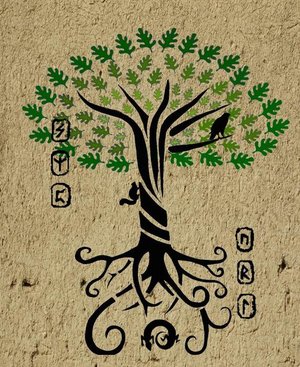
  Yggdrasil and the Norns are getting their own post out of my love and respect for all of them.

19.  An ash I know,  Yggdrasil its name,
      With white water  is the great tree wet;
      Thence come the dew  that falls in the dales,
      Green by Urth's well  does it ever grow.


The Poetic Edda - Voluspo : Stanzas 17 and 18

  We have now come to the creation of the first man and woman of Midgard by Odin, Hoenir (Honir) and Lodur (Lothur).

17. Then from the throng of  did three come forth
      From the home of the gods,  mighty and gracious;
      Two without fate on  the land they found,
      Ask and Embla,  empty of might.

18. Soul they had not,  sense they had not,
      Heat nor motion,  nor goodly hue;
      Soul gave Othin,  sense gave Honir,
      Heat gave Lothur  and goodly hue.


Ask and Embla

Tuesday, October 29, 2013

Voluspo: Stanzas 6,7 and 8

To continue from Poetic Edda:

 6. Then sough the gods their assembly-seats,
The holy ones, and council held;
Names then gave they to noon and twilight,
Morning they named, and the waning moon,
Night and evening, the years to number.

7.  At Ithavoll met the mighty gods,
Shrines and temples they timbered high;
Forges they set, and smithied ore,
Tongs they wrought, and tools they fashioned.

8. In their dwelling at peace they played at tables,
Of gold no lack did the gods then know, --
Till tither came up giants-maid three,
Huge of might , out of Jotunheim.


Saturday, August 24, 2013

Thursday, August 15, 2013

Var/Vor


Var/Vor is the Norse goddess wisdom, marriage, faith,oaths,promises and contracts.
In the Poetic Edda, the blessed Vor is invoked by the king of the jotunn (giant) Thrymr after his "bride" ( who was actually the god Thor disguised as Freyja) is sacred with Mjolnir, the stolen hammer of Thor, at their wedding.

  In the 35th chapter of the Prose Edda book Gylfaginning, High,one of the three men who answer question posed to them by Gangleri (Gylfi in disguise) about the asynjur. High list Vor as nineth among the sixteen asynjur he presents in the chapter and provides some information about her:
 

     Ninth Var : she listens to peoples oaths and private agreements that women and men make between each other. Thus these oaths are called varvar.She punishes those that break them.

  Also, Var makes two more appearances in the Prose Edda. In Chapter 75 of the Prose Edda book Skaldskaparmal Var 's name appears in a list of 27 asynjur names. In Chapter 87 the name Var is used in a kenning referring to the goddess Skaoi ("bow-string-Var") in the poem Haustlong . A runic inscription inscribed on a stick in Beregen, Norway around 1300 records a common mercantile transaction follwed by a verse of an unsatisfied customer that mentions Var.

     'Wise Var of wire ( "woman of filigree" meaning "wise bejeweled woman") makes (me) sit unhappy.
       Eir(woman) of mackerels'  ground (likely gold) takes often and much sleep from me."

  There are theories regarding the importance of Var as a goddess. Britt-Mari Nasstrom argues that Var was like many other minor goddesses and was one of the many names of the goddess Freyja and was "later apprehended as independent goddesses".
                                                                                                                                                           
The Austrian Germanist and philologist, Rudolf Simek says that the goddesses Saga, Hlin, Snotra, Vor and Var should be considered vaguely defined figures who"who should be seen as female protective goddesses" that are responsible for 'specific areas of the private sphere, and yet clear differences were made between them so they are in many ways similar to matrons."


Saturday, July 27, 2013

Voluspo: Stanzas 3, 4 and 5

From Henry Adams Bellows stanzas 3 and 4 of the Voluspa from The Poetic Edda


3. Of old was the age of  when Ymir lived;
Sea nor cool waves  nor sand there were;
Earth had not been,   nor heaven above,
But a yawning gap,  and grass nowhere.

4. The Bur's sons lifted  the level land,
Mithgarth the mighty  there they made;
The sun from the south  warmed the stones of the earth,
And green was the ground  with growing leeks.

5. The sun, the sister  of the moon, from the south
her right hand cast  over heaven's rim;
No knowledge she had  of where her home should be,
The moon knew not  what might was his,
The stars knew not  where their stations were.


Mithgarth(Midgard)


Friday, June 21, 2013

Voluspo: Stanzas 1 and 2

The first set of the translated Voluspa is from Henry Adams Bellows in 1936 from Icelandic. Al I can seem to find on a Mr. Bellows is that he was a Vermont-born New Hampshire lawyer, state legislator and jurist that lived from 1803-1873. His translation:

1. Hearing I ask  from the holy races,
From  Heimdall's sons,  both high and low;  
Thou wilt, Valfather,  that well I relate
Old tales I remember  of men long ago.

2. I remember yet  the giants of yore
Who gave me bread  in the days gone by;
Nine worlds I knew,  the nine in the tree
With mighty roots  beneath the mold.


The second translation is from Lee M. Hollander, an American scholar of Norse literature and mythology. he was a long-term faculty member and head of the Department of Germanic Studies at the University of Texas in Austin. Professor Holland lived from 1880 to 1972. His translation:


Hear me, all ye hallowed beings
Both high and low of Heimdall's children;
Thou wilt Valfather, that I well set forth
The fates of the world which I first recall

I call to mind the kin of etins
which long ago did give me life.
Nine worlds I know, the nine abodes
Of the glorious world-tree the ground beneath